
Minimum Order Quantity (MOQ) for Clothing Manufacturers in India: A Practical Guide for Bulk Buyers
Minimum Order Quantity (MOQ) for Clothing Manufacturers
If you are planning a bulk menswear order, the first number that decides everything is the MOQ. Knowing the minimum order quantity (MOQ) for Indian garment manufacturers affects your per-unit price, fabric choices, customisation, size ratios, delivery schedule, and eventually your profit margins. It’s not simply about hitting a piece count. Yet most buyers discover these trade-offs only after they have already committed. Written from the floor of an operating menswear factory in Ludhiana, this tutorial explains MOQ in simple words so you can confidently plan your next purchase and select the best Indian men’s clothing manufacturer.
MOQ Clarity
Know the minimum before you order.
Price Control
Better quantity, better margins.
Smart Product Mix
Order what can actually sell.
In-House Production
Direct factory, fewer surprises.
What is the minimum order quantity (MOQ) for Indian apparel manufacturers?
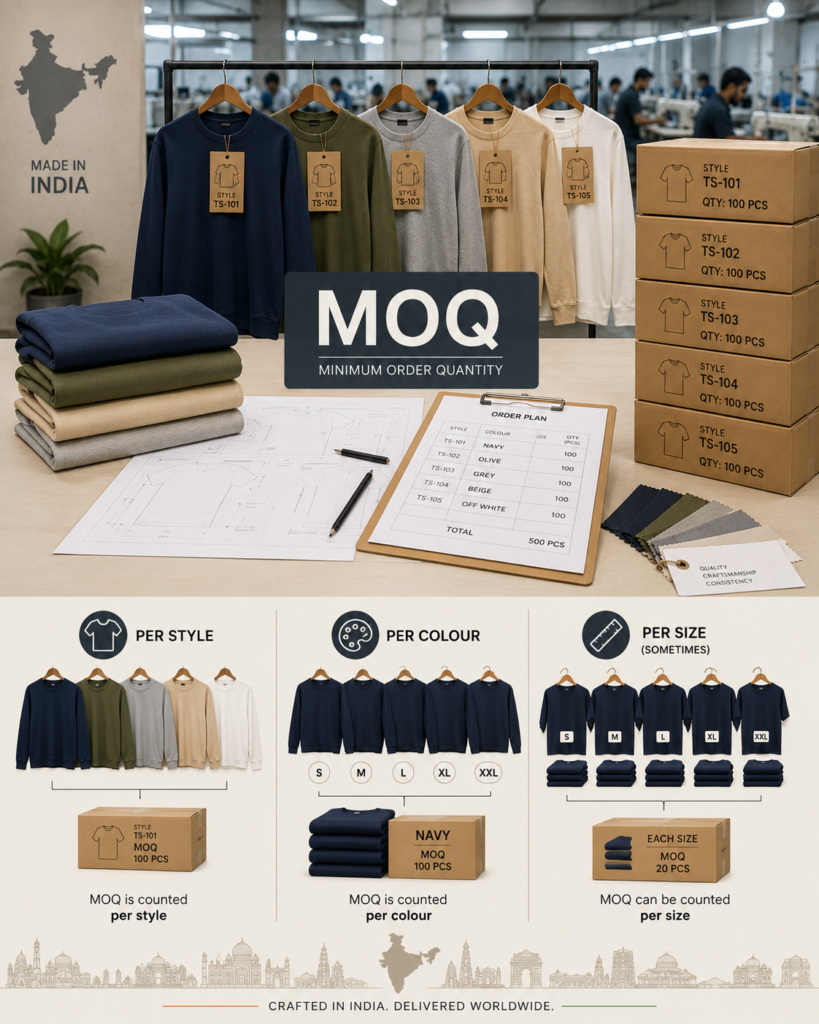
MOQ refers to the least number of items that a factory is willing to manufacture in a single production run. In practice, the minimum order quantity (MOQ) for clothing manufacturers in India is usually quoted per style and per colour, not as one lump figure. Inside that, there is often a minimum per size too — commonly around 25 pieces per size — so the factory can cut a balanced size ratio (S–M–L–XL–XXL) instead of odd, unsellable quantities.
So when a manufacturer says “MOQ 300”, ask the real question: is that 300 total, 300 per colour, or 300 per style? The answer changes your costing completely.
Why do clothing manufacturers have an MOQ?
MOQ exists because of fixed costs. Pattern making, marker planning, machine setup, sampling and fabric sourcing cost almost the same whether you produce 50 garments or 5,000. Garment manufacturing MOQ simply spreads those fixed costs across enough pieces to keep the per-unit price sensible.
Fabric is the bigger driver. Mills set their own minimums — often 500 to 1,000 metres per colour and quality — so when you ask for a custom-dyed shade or a special fabric, the apparel manufacturing MOQ rises to match what the mill demands. This is why “just make me 50 pieces in a custom colour” is rarely viable, while 50 pieces in a running stock fabric sometimes is.
Typical minimum order quantity (MOQ) for clothing manufacturers in India
There is no single national figure, and any manufacturer who quotes one without asking about your product is guessing. That said, the typical minimum order quantity (MOQ) for clothing manufacturers in India falls into broad bands:
- Low-MOQ / small-batch units: roughly 50–100 pieces per style, aimed at startups and test runs.
- Established, in-house factories: roughly 200–300+ pieces per style or colour, which is where pricing becomes genuinely competitive.
- Custom fabric or heavy customization: higher, because mill and process minimums apply.
MOQ also shifts sharply by product type:
T-shirts and basics: The lowest minimums. Round-neck and polo T-shirts use widely available knit fabric and simple construction, so they are the easiest fast-moving SKU to start with.
Sweatshirts and hoodies: Moderate MOQs. Heavier fleece (often 300–450 GSM), extra panels, zippers and drawcords mean more fabric and more operations per piece.
Shirts and casuals: Moderate to higher. Woven fabric, collars, plackets and buttons add operations, and woven mills often have higher fabric minimums than knits.
Joggers and lowers: Moderate. Elastic waistbands, drawcords and pockets add steps, but these are high-repeat SKUs that justify a solid run.
Co-ord sets and tracksuits: The highest effective MOQ, because you are really making two garments — two patterns, two fabrics or processes — that must be produced in matching ratios.
Why MOQ differs from one manufacturer to another
Two factories can quote very different numbers for the same T-shirt. The clothing manufacturer’s MOQ in India depends on:
- Fabric: running stock fabric lowers MOQ; custom-dyed or specialty fabric raises it.
- Design complexity: more panels, trims and operations push minimums up.
- Printing and embroidery: screen printing has its own setup minimum per design; embroidery and all-over prints add further minimums.
- Colour options: each colour is usually a separate MOQ, so five colours can multiply your commitment.
- Size ratios: a wide size set with a per-size minimum increases the total.
- Production capacity and model: a true manufacturer with in-house lines can plan minimums around its own machines; a trader is stuck with whatever the actual factory dictates.
That last point matters more than buyers realise — which is exactly why the type of supplier you pick drives the MOQ you are offered.
How MOQ affects your pricing and margins
The minimum order quantity (MOQ) for clothing manufacturers in India and your price move together. At low volumes, fixed costs sit on very few pieces, so the per-unit cost is high. As the quantity rises, that fixed cost is divided across more garments and the price per piece drops — the classic economy of scale. A higher MOQ usually means a lower cost price and a healthier retail margin; a very low MOQ buys flexibility but you pay for it per piece. The smart approach is to match MOQ to your real sell-through so you neither overpay per unit nor get stuck with dead stock.
Planning a bulk menswear order? See our full product portfolio and tell us your target quantities — we'll suggest a practical mix.
MOQ for retailers vs wholesalers
Wholesalers and distributors typically buy deep across fewer styles, so they comfortably clear standard MOQs and unlock the best pricing. Individual retailers and new labels often want many styles in smaller depth, which fights against MOQ. The fix is consolidation: order fewer styles in stronger quantities, or work with a manufacturer who lets you combine styles within the same fabric to reach an efficient run. Either way, the minimum order quantity (MOQ) for clothing manufacturers in India rewards depth over scattered, shallow buys.
MOQ for custom designs vs ready stock
Since the fabric and patterns are pre-existing, ready-stock and running designs have the lowest minimums. Because they require new fabric, sampling, and setup, custom designs—your own fits, custom colours, private-label branding, and unique prints—carry higher minimums. Start with ready-made or semi-custom styles, demonstrate the sell-through, and then expand into totally custom production if you are testing the market.
Things to think about before making a big purchase
Prior to confirming anything, find out if the MOQ is for each style, colour, or size. What is the ratio’s minimum for each size? Does the MOQ increase with my customisation (print, embroidery, custom colour)? Can I get the minimum by combining styles in the same fabric? Before the bulk, will I receive a pre-production sample? After sample approval, how long is the lead time? Is it possible to scale up later without resampling? A true factory can be distinguished from a middleman by providing clear responses.
How to choose the right men's apparel manufacturer in India
MOQ is ultimately a reflection of the supplier. A genuine men’s apparel manufacturer in India with in-house production can offer practical, transparent minimums, advise you on a sellable product mix, and hold your delivery date — because it controls the machines, not a chain of intermediaries. A trader cannot. So before you compare quotes, decide what kind of men’s apparel manufacturer in India you actually want to build a long-term supply relationship with.
At Montu Shallu Knitwears (home to our wholesale label EXES), we are a manufacturing unit, not a trading company. Based in Ludhiana — one of India’s major knitwear and apparel manufacturing hubs — we produce T-shirts, sweatshirts, hoodies, shirts, joggers, lowers and co-ord sets in-house. We understand fast-moving menswear SKUs, we help retailers build practical product mixes that actually sell, and we back every bulk and B2B order with timely delivery and after-sales support. That is the difference a real wholesale clothing manufacturer in India makes to your MOQ conversation.
Final checklist before placing your bulk order
Confirm MOQ basis (style/colour/size); lock your size ratio; finalise fabric and GSM; decide colours (remember each is its own minimum); confirm print/embroidery setup minimums; approve a pre-production sample; agree lead time and dispatch date in writing; and align quantities to your expected sell-through. Tick these and your bulk order will run smoothly.
FAQs
What is the typical minimum order quantity (MOQ) for clothing manufacturers in India?
It varies by category and customization. Basics like T-shirts can start lower (around 50–100 pieces per style at small-batch units), while established in-house factories work efficiently at roughly 200–300+ pieces per style or colour. Custom fabric or heavy customization raises the minimum.
Is MOQ calculated per style or per colour?
Usually per style and per colour, often with a minimum per size inside the ratio. Always confirm the basis before costing.
Does customization increase the MOQ?
Yes. Custom colours, special fabrics, all-over prints and embroidery carry their own minimums, so they push the MOQ up.
Can I mix different styles to meet the MOQ?
Often yes, if the styles share the same fabric. Ask your manufacturer — a flexible in-house factory can usually arrange this.
What is the lead time after I approve the sample?
Typically around 30–90 days depending on quantity, fabric availability and complexity. In-house production helps keep this predictable.